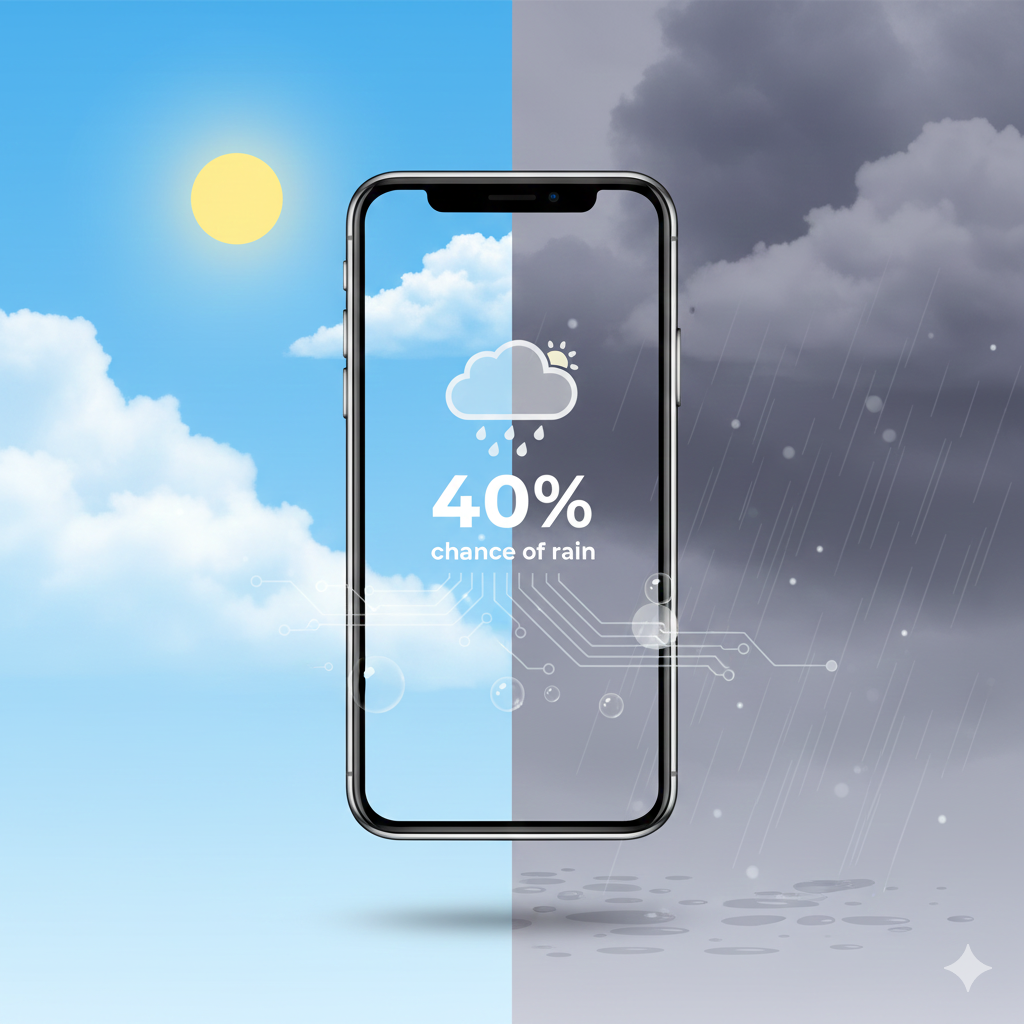

I’ll never forget the day I confidently left my umbrella at home because the weather app showed only a “40% chance of rain.” Later, caught in a surprise downpour that ruined my new sneakers, I shook my fist at the sky and my phone. “Forty percent? That means it probably won’t rain, right?” I felt confused and a little betrayed. If you’ve ever had a similar moment, you’re not alone. This single phrase is one of the most common and misunderstood concepts in daily weather forecasting. It seems straightforward, but its true meaning is a subtle dance of probability and geography that, once decoded, will make you a much smarter planner.
A “40% chance of rain” means there is a 4 in 10 chance that measurable rain (at least 0.01 inches) will fall at any given point within a specific forecast area. It does not mean that 40% of the area will get rain, or that it will rain for 40% of the day.
🧠 What Does “40% Chance of Rain” Actually Mean?
Let’s cut through the meteorological jargon. When your local weather service issues a forecast with a “40% chance of rain,” officially known as a Probability of Precipitation (PoP), they are answering two critical questions:
- How confident are we that it will rain? (Confidence)
- If it does rain, how much of the area will be affected? (Coverage)
The simple formula they use is: Probability of Precipitation (PoP) = Confidence x Coverage.
So, for our 40% chance, this could break down in a few different ways. A forecaster might be:
- 80% confident that rain will develop, but it will only cover 50% of the forecast area. (0.8 x 0.5 = 0.4 or 40%)
- 100% confident that rain will occur, but it will be very isolated, only affecting 40% of the area. (1.0 x 0.4 = 0.4 or 40%)
The key takeaway is that the percentage refers to the probability of you getting wet at any single location within the forecast zone—like your house, your commute, or your favorite park.
In short: 40% Chance of Rain = A 4 in 10 chance that measurable rain will fall on your specific location.
📱 Where Do You Find and Use This Forecast?
You encounter the “chance of rain” forecast almost everywhere you check the weather. Its usage is universal because it effectively communicates uncertainty.
- Weather Apps & Websites 🌐 (The Weather Channel, AccuWeather, your phone’s native app)
- Television & Radio Broadcasts 📺 (Your local news meteorologist)
- Smart Home Devices 🗣️ (“Hey Google, what’s the weather today?”)
- Formal NOAA/NWS Forecasts ⛈️ (The source for most other services)
This forecast is inherently casual and informational. It’s not a definitive “yes” or “no,” but a helpful guide for your daily decisions. It’s perfectly suited for planning a picnic, a run, a commute, or a construction project—any situation where knowing the risk of rain is valuable.
💬 Breaking Down the Confusion: Real-World Scenarios
Let’s look at how this forecast plays out in everyday life through simple conversations.
Scenario 1: The Picnic Planners
Alex: “Hey, should we move the picnic inside? The app says a 40% chance of rain.”
Sam: “Nah, that means there’s a 60% chance it stays dry! Let’s risk it. We can always pack up quickly.”
Scenario 2: The Morning Commute
Parent: “Don’t forget your raincoat, sweetie. It’s supposed to rain today.”
Teen: “Mom, it’s only a 40% chance. That’s less than half. I’ll be fine.”
Scenario 3: The Gardener
Neighbor A: “I was going to water my plants, but with this 40% PoP, I might hold off.”
Neighbor B: “Smart. If you get one of those passing showers, it’ll do the work for you. If not, you can water tomorrow.”
Scenario 4: The Outdoor Wedding
Planner: “We have a contingency plan for the ceremony. The 40% chance is concerning, but it’s not high enough to call off the outdoor setup just yet.”
🕓 When to Use and When to Ignore a 40% Forecast
Understanding the probability is one thing; knowing how to act on it is another.
✅ When to Use the 40% Forecast as Your Guide
- Planning Casual Outdoor Activities: A 40% chance is a yellow light, not a red one. Go ahead with your picnic, hike, or bike ride, but have a “Plan B” ready.
- Making Low-Stakes Daily Decisions: Deciding whether to carry an umbrella, wear a rain jacket, or water the lawn. The forecast gives you a logical reason to make that choice.
- Understanding Weather Patterns: Use it to gauge the type of weather expected. A 40% chance often suggests scattered showers or pop-up thunderstorms, not a widespread, all-day soaker.
❌ When Not to Rely Solely on the Percentage
- For High-Stakes Outdoor Events: If you’re planning a wedding, a major concert, or a costly outdoor photoshoot, a 40% chance is too high to ignore. Dig deeper into the forecast details.
- When the Forecast Says “Isolated” or “Widely Scattered”: These words paired with 40% mean the rain will be very hit-or-miss. You could be in a lucky “miss” zone or an unlucky “hit” zone.
- Assuming It’s a Guarantee of Dry Weather: A 40% chance is not a 0% chance. It’s a substantial enough probability that you should not be shocked if it rains.
Contextual Guide to “Chance of Rain”
| Context | Example Scenario | Why the 40% Forecast Works (or Doesn’t) |
|---|---|---|
| Friend’s Backyard BBQ | “I’ll set up the grill, but let’s keep the sides indoors just in case.” | It encourages a flexible, low-risk plan that acknowledges the possibility of rain without canceling the event. |
| Daily Commute to Work | “I’m leaving the raincoat but tossing a compact umbrella in my bag.” | It prompts a small, reasonable precaution for a manageable situation. |
| Formal Outdoor Wedding | “We are activating the tent rental plan due to the chance of precipitation.” | A 40% risk is too high for a once-in-a-lifetime, expensive event; definitive action is needed. |
| Agricultural Planning | “I won’t irrigate the west field today and will wait to see if the forecasted showers materialize.” | The forecast is used as a direct input for a cost/benefit business decision. |
🔄 Similar Weather Probability Terms Explained
The “chance of rain” is just one way meteorologists communicate uncertainty. Here are other terms you might see and what they mean in comparison.
| Term | Meaning | When You’ll See It |
|---|---|---|
| Slight Chance | A low probability, typically between 10-20%. | When conditions are marginally favorable for a brief shower. |
| Chance | A noticeable probability, typically 30-50%. | Our 40% example falls here. The most common wording. |
| Likely | A high probability, typically 60-70%. | When widespread rain is expected, but not guaranteed for 100% of the area. |
| Isolated Showers | Rain will affect less than 30% of the area. | Often paired with a “slight chance” or “chance” forecast. |
| Scattered Showers | Rain will affect 30-50% of the area. | The classic description for a 30-50% PoP day. |
| Widespread Rain | Rain will affect over 50% of the area. | Usually paired with a “Likely” or “Certain” forecast. |
🌐 The Science Behind the Number: How Forecasters Calculate PoP
This isn’t just a guess; it’s a sophisticated scientific estimate. Meteorologists use a combination of powerful tools to arrive at that 40% figure.
- Computer Model Data: Supercomputers run complex mathematical models of the atmosphere. Forecasters analyze multiple models, looking for consistency in predicting moisture, lift, and temperature.
- Historical Data & Analog Patterns: They compare current weather patterns to similar historical situations. How often did it rain in the past under these precise conditions?
- Forecaster Confidence & Expertise: This is the human element. An experienced meteorologist synthesizes all the data, understands the local geography (like lake or mountain effects), and applies their own judgment to fine-tune the final percentage.
🤔 Common Myths and Misconceptions About the 40% Forecast
Let’s officially bust some of the most persistent myths.
- Myth 1: It means 40% of the area will get rain.
- Truth: It refers to the chance of rain at any point in the area, not the percentage of landmass covered.
- Myth 2: It means it will rain for 40% of the day.
- Truth: The percentage has no direct correlation with the duration of the rain. A 40% chance could mean a 10-minute downpour or several short bursts.
- Myth 3: A 50% chance means it’s a toss-up, like a coin flip.
- Truth: While it represents equal odds, meteorologically, it indicates that rain is a significant possibility and you should definitely plan for it.
💡 How to Be Smarter Than the Forecast: Your Action Plan
Now that you’re an expert, here’s how to use a “40% chance of rain” forecast effectively:
- Don’t Just Look at the Number: Read the full forecast description. Words like “scattered,” “isolated,” “afternoon,” or “evening” give crucial context.
- Check the Radar: A quick look at a live radar map can show you if the rain is actually forming and moving toward you.
- Always Have a Plan B: For any non-essential outdoor activity, know what you’ll do if the rain arrives.
- When in Doubt, Carry the Umbrella: The mental cost of carrying a small umbrella is far less than the physical cost of getting soaked.
❓ FAQs About the 40% Chance of Rain
1. Is a 40% chance of rain considered high?
It’s considered a moderate chance. It’s high enough that you should definitely be aware of the possibility and have a backup plan, but not so high that you should automatically cancel your outdoor plans. It’s the forecast that says, “Be prepared, but don’t despair.”
2. Why do I sometimes see a 40% forecast and it doesn’t rain at all?
This is a perfect example of probability in action. A 40% chance also means a 60% chance of no rain. You simply ended up in the more likely, dry scenario. The forecast was not “wrong”; the less probable outcome just occurred for your location.
3. What’s the difference between “chance of rain” and “probability of precipitation”?
There is no difference. “Probability of Precipitation” (PoP) is the official meteorological term, while “chance of rain” is the public-friendly phrasing. They mean the exact same thing.
Conclusion
Decoding the “40% chance of rain” transforms it from a confusing statistic into a powerful planning tool. It’s not a prediction of doom or a promise of sunshine, but a nuanced expression of risk. It tells you that the atmosphere has a decent shot at producing rain, but it’s far from a sure thing. The next time you see that number, you can smile, knowing you’re in on the secret. You’ll grab your umbrella not out of confusion, but with the confident understanding of a true weather pro. Now, go forth and plan your day with clarity