
I was watching a British detective show, utterly engrossed, when the seasoned inspector laid out the final clue. “The butler did it in the library with the candlestick,” he declared, “and Bob’s your uncle, we’ve got our killer!” I nearly spat out my tea. Bob? Who’s Bob? What does his nephew have to do with anything? I was lost in a sea of confusion, the plot’s resolution suddenly overshadowed by this bizarre, familial non-sequitur. If you’ve ever had a similar moment of bafflement, you’ve come to the right place. Let’s demystify this wonderfully peculiar phrase together.
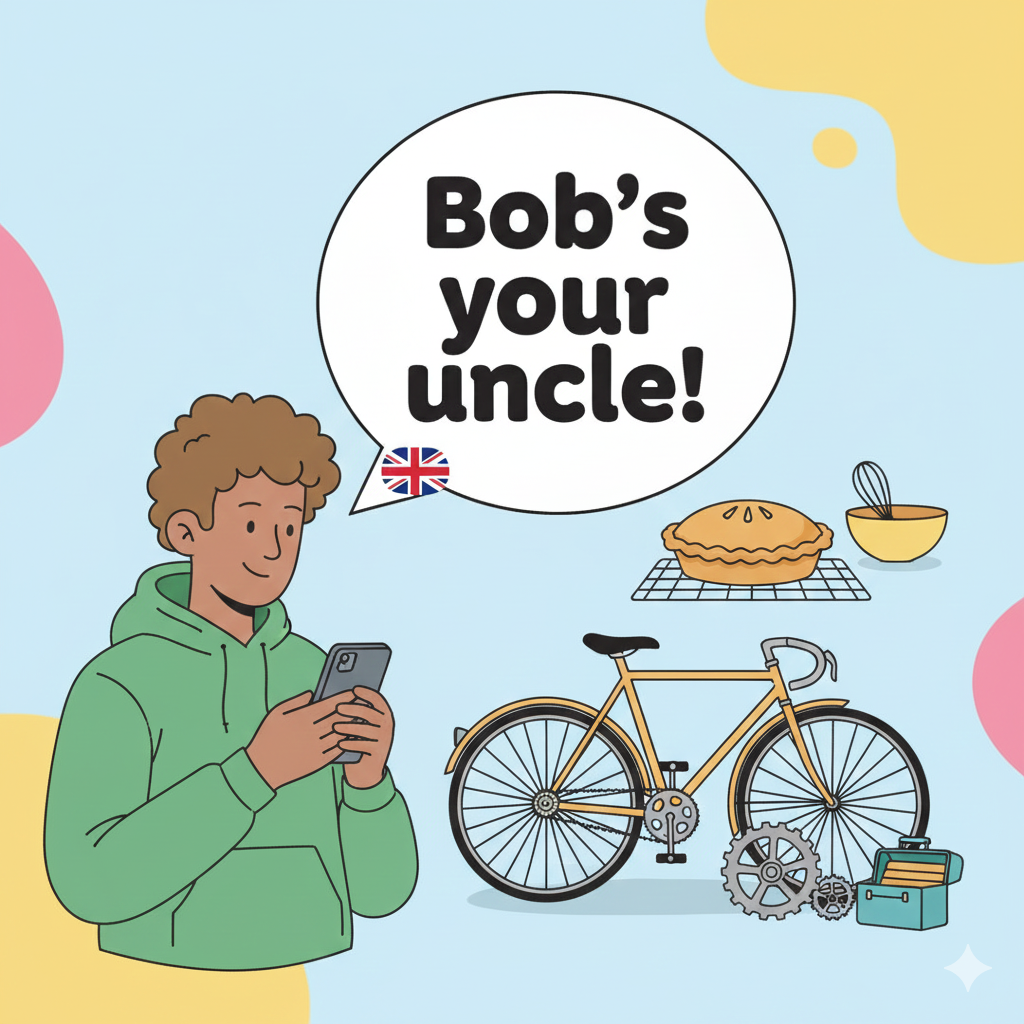
“Bob’s your uncle” is a classic British slang phrase that means “and there you have it!” or “it’s as simple as that!” It’s a casual, cheerful, and often slightly humorous way to indicate that something is effortlessly accomplished or a conclusion is easily reached.
🧠 What Does “Bob’s Your Uncle” Actually Mean?
At its heart, “Bob’s your uncle” is an idiom used to signify the effortless completion of a task or the simple, straightforward nature of a process. It’s the verbal equivalent of a magician’s “ta-da!” You use it after giving a set of instructions or stating a fact to emphasize how easy the outcome will be. For instance, if you explain a simple recipe, you might end with, “…pop it in the oven for 20 minutes, and Bob’s your uncle, you’ve got a delicious cake!
The phrase implies that with the steps provided, success is guaranteed—as if you had a powerful uncle named Bob pulling strings for you. It carries a tone of cheerful finality and is deeply embedded in British, Irish, Commonwealth, and now global informal English.
In short: Bob’s your uncle = And there you have it! = It’s as simple as that!
📜 The Curious Origins of “Bob’s Your Uncle”
To truly understand this phrase, we need to take a quick trip back to late 19th-century British politics. The most popular and widely accepted theory points to a genuine case of nepotism.
In 1887, British Prime Minister Robert “Bob” Salisbury appointed his rather inexperienced nephew, Arthur Balfour, to the prestigious and politically sensitive post of Chief Secretary for Ireland. The appointment was seen as a blatant act of favoritism. It was so shocking that it sparked public outrage and was famously lampooned in the press. The phrase “Bob’s your uncle” is believed to have sprung from this scandal, sarcastically meaning that if “Bob” is your uncle, you can effortlessly get any high-ranking job you want. The phrase evolved from a specific political joke into a general expression for something achieved with ridiculous ease.
📱 Where Is “Bob’s Your Uncle” Commonly Used?
While its roots are firmly British, this phrase has traveled far and wide. You’ll encounter it in various contexts:
- 🇬🇧 In the UK & Commonwealth Nations: This is its natural habitat. Used in everyday speech, from the pub to the workplace (in casual settings).
- 🎬 In Film and Television: A staple in British comedies, dramas, and period pieces. It’s often used to quickly establish a character as British.
- 💬 On Social Media (Twitter, Reddit, Facebook): Used in captions for life hacks, simple recipes, or “how-to” videos to add a touch of British charm.
- ✍️ In Informal Writing: You might see it in blog posts, light-hearted articles, or personal messages.
- 🎮 In International Gaming Chats: As gaming communities globalize, this phrase pops up, sometimes confusing non-native speakers!
Tone & Formality: It is overwhelmingly casual and informal. It’s friendly, slightly cheeky, and never used in formal reports, official documents, or serious academic writing.
💬 Examples of “Bob’s Your Uncle” in Conversation
Let’s see how this phrase works in realistic, modern conversations.
- Giving Simple Directions
- A: “How do I get to the museum from here?”
- B: “Take the first left, walk straight for two blocks, and Bob’s your uncle, you’re there!”
- Explaining a Tech Fix
- A: “My Wi-Fi is so slow, I can’t get anything done.”
- B: “Just unplug the router, count to ten, and plug it back in. Bob’s your uncle, it should be fixed.”
- Following a Simple Recipe
- A: “This looks complicated.”
- B: “Nah, it’s easy. Mix the flour and eggs, pour in the milk, give it a whisk, and Bob’s your uncle—perfect pancake batter.”
- Assembling Furniture
- A: “I hate these flat-pack instructions.”
- B: “Just slot A into B, tighten that screw, and Bob’s your uncle—a brand-new bookshelf!”
- Summarizing a Simple Plan
- A: “So, the plan for Saturday?”
- B: “We meet at the station at 10, catch the 10:15 train, and Bob’s your uncle, we’re at the beach by 11.”
- In a Text Conversation
- A: sends a link to a complicated-looking dance tutorial
- B: “lol that’s not hard. It’s just step, step, turn, and bob’s your uncle 😉”
🕓 When to Use and When Not to Use “Bob’s Your Uncle”
Navigating the use of this idiom is key to sounding natural, not awkward.
✅ When to Use “Bob’s Your Uncle”
- In casual conversations with friends, family, and colleagues you know well.
- When giving simple, step-by-step instructions that lead to a guaranteed, easy result.
- To add a touch of humor or light-heartedness to a statement.
- When you want to sound distinctly British or charm someone with British slang.
❌ When NOT to Use “Bob’s Your Uncle”
- In formal writing, such as business reports, academic papers, or official emails.
- During serious, sensitive, or somber conversations.
- When explaining something that is actually complex or difficult (it would sound sarcastic or dismissive).
- In high-stakes or urgent situations where clarity is paramount (e.g., emergency instructions).
| Context | Example Phrase | Why It Works (or Doesn’t) |
|---|---|---|
| Friend Chat | “Just add the plugin to your browser, and bob’s your uncle, it’ll block all ads!” | Casual, friendly, and simplifies the process. |
| Work Chat (Casual) | “Merge those two cells, paste the formula here, and bob’s your uncle, the report is done.” | Acceptable in a relaxed office environment with familiar coworkers. |
| Formal Work Email | “Please follow the outlined steps in section 3.2 to complete the data compilation.” | Formal and clear; the slang would be unprofessional. |
| A Eulogy or Sympathy Card | My deepest condolences during this difficult time.” | Serious and respectful; the slang would be wildly inappropriate. |
🔄 Similar Slang Words & Alternatives
“Bob’s your uncle” isn’t alone in the world of “it’s that easy” expressions. Here are some alternatives from English and other languages.
| Slang / Phrase | Meaning | When to Use |
|---|---|---|
| And there you have it! | Literally means “that’s the result.” | A versatile, slightly more formal alternative that works in most casual contexts. |
| Easy peasy (lemon squeezy) 🍋 | Emphasizes that something is very easy. | Very informal and playful, perfect with kids or in a very lighthearted setting. |
| It’s a piece of cake. 🍰 | Something is very easy to do. | A common, well-understood idiom in American and British English. |
| No sweat. | Indicates that a task requires no effort. | Casual and reassuring, often used as a response to a request. |
| Voilà! (French) | Literally “see there!” Used to present a result. | Sophisticated and widely understood; great for presenting a finished product. |
| Hey presto! | A magician’s phrase for “and now, the magic happens!” | Similar to “Bob’s your uncle,” with a more theatrical, conjuring flair. |
| Good to go. | Everything is ready and complete. | Casual, often used in military or operational contexts, now common everywhere. |
| Sorted! (UK) | Means something has been dealt with and resolved. | Very British and colloquial, implying a problem is now fixed. |
| Job’s a good’un. (UK) | The job is finished and done well. | A regional British alternative, very informal and satisfied. |
| And that’s that. | A definitive way to end an explanation. | Can be neutral or slightly abrupt; emphasizes finality. |
❓ FAQs About “Bob’s Your Uncle”
1. Is “Bob’s your uncle” rude or offensive?
Not at all! It’s generally seen as friendly and cheerful. However, as with any casual slang, using it in a very formal or serious context would be considered inappropriate, not because the phrase itself is offensive, but because it’s a tonal mismatch.
2. Do Americans say “Bob’s your uncle”?
While it’s not a standard part of American English, many Americans are familiar with the phrase from British media. An American might use it to sound witty or British, but their go-to equivalents would be “and there you have it,” “it’s as simple as that,” or “easy peasy.”
3. Is there a response to “Bob’s your uncle”?
Not really. It’s typically used to cap off a statement, so the natural response is to acknowledge the completed instruction or the result itself. You might just say “Great, thanks!” or “Oh, that is easy!”
4. Can “Bob’s your uncle” be used sarcastically?
Absolutely. Like many idioms, its meaning can be flipped with tone. If someone gives you a long, convoluted set of instructions and ends with “and Bob’s your uncle,” they are likely being sarcastic, highlighting that the process is actually anything but simple.
🎯 Conclusion
So, there you have it. The mystery of the phantom Uncle Bob is solved. From a scandalous act of political nepotism in the 1880s to a cheerful staple of modern informal English, “Bob’s your uncle” has had quite the journey. It’s a phrase that adds color, character, and a dash of British charm to your language.
Now that you’re in the know, why not try it out? The next time you explain how to make a cup of tea, fix a wobbly chair, or find the best meme in a subreddit, just remember the final step: add the instructions, finish with a confident “and Bob’s your uncle,” and enjoy the look of understanding (or confusion) on your friend’s face. You’ve just leveled up your slang game.