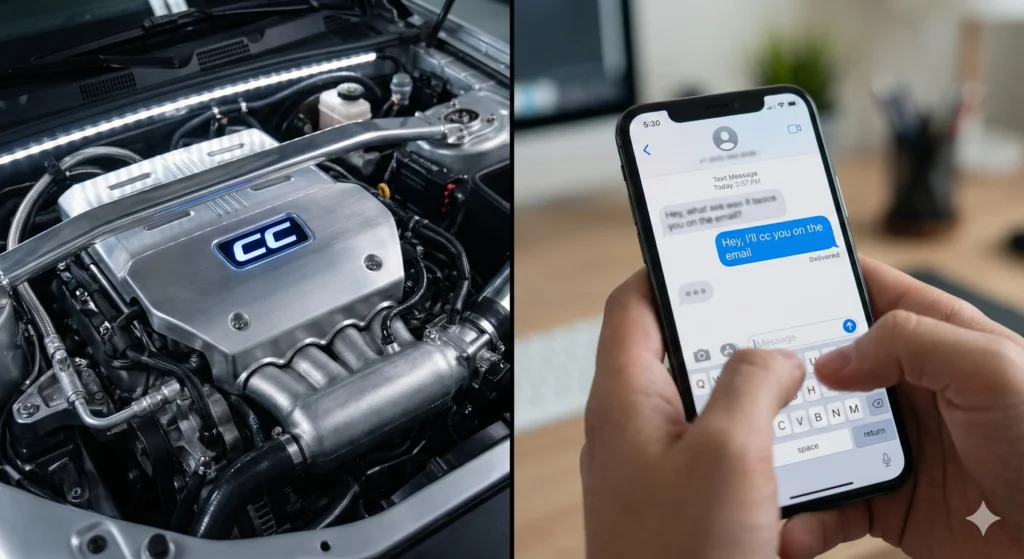

Have you ever been scrolling through a car forum, deep in a debate about horsepower, only to see someone drop a casual “cc” and leave you utterly baffled? Or maybe you’re in a group chat, planning a road trip, and a friend texts, “cc me on the location details, please!” Your brain does a quick double-take. Wait, are we talking about engines or emails? If you’ve ever felt that jolt of confusion, you’re not alone. In the digital and mechanical worlds, “cc” is a classic shape-shifter—a tiny acronym that carries massive weight in two completely different universes. Let’s pop the hood on this term and decode its dual life.
In engines, “CC” most commonly stands for “Cubic Centimeters.” It’s a technical measurement referring to an engine’s total displacement or size. In texting/email, “CC” means “Carbon Copy,” a polite and functional way to add someone to a conversation or keep them in the loop.
🧠 What Does CC Mean in Text and Email?
Let’s start with the digital side, as it’s the one you’re more likely to encounter in daily messaging. Here, CC is an abbreviation for “Carbon Copy.” This term is a relic from the pre-digital age when people used carbon paper to make instant duplicates of typed or handwritten documents. The “carbon copy” was the second sheet that received the impression.
In modern texting, Slack, Discord, and especially email, “CC” has retained its core function: to include an additional person in a conversation for their information. It signals, “You don’t necessarily need to reply, but you should see this.” It’s a courtesy, a way to keep people informed without making them the primary recipient (that’s the “To:” field).
Example: “Hey team, I’ve attached the meeting agenda. CCing Mark from marketing so he’s aware of our discussion points.”
In short: CC = Carbon Copy = “Keeping you in the loop.”
🚗 What Does CC Mean in Engines (Cubic Centimeters)?
Now, shift gears to the garage. In automotive and engine terminology, CC stands for “Cubic Centimeters.” This is a unit of volume used to measure an engine’s displacement.
What is engine displacement? Imagine the cylinders in your car’s engine. Displacement is the total volume all of the pistons sweep through as they move from bottom to top. More cubic centimeters (or liters, where 1000cc = 1L) generally means more space for the air-fuel mixture, which can lead to more potential power.
- A 150cc scooter has a small engine.
- A 2000cc (2.0L) sedan has a midsize engine.
- A 5000cc (5.0L) muscle car has a large, powerful engine.
When someone says, “It’s a 600cc bike,” they are telling you its engine’s size class. It’s a fundamental spec, like height for a person.
In short: CC (Engines) = Cubic Centimeters = “The size of the engine’s ‘lungs’.”
📱 Where Is “CC” Commonly Used?
This acronym thrives in specific, context-driven ecosystems:
For “Carbon Copy” (Digital):
- 📧 Email Clients (Gmail, Outlook): The fundamental CC field.
- 💬 Work & Project Apps (Slack, Microsoft Teams): “Just cc’d you on that thread.”
- 📱 Group Texting (iMessage, WhatsApp): “I’ll cc you on the details for the party.”
- 🏢 Formal & Professional Communication: Anywhere transparency and information sharing are key.
For “Cubic Centimeters” (Mechanical):
- 🏍️ Motorcycle & Scooter Specs: The primary way to categorize bikes (e.g., 300cc class).
- 🚗 Car Reviews & Forums: Discussing engine size and performance.
- 🛠️ Mechanical Manuals & Sales Listings: A core technical specification.
- 🏎️ Racing & Automotive Hobbyist Communities.
Tone: “CC” (Carbon Copy) is functional and polite, often neutral-to-formal. “CC” (Cubic Centimeters) is purely technical and descriptive.
💬 Examples of “CC” in Conversation
Example 1: Carbon Copy (Work Email)
A: “Sending the client proposal over now. I cc’d you, Sam, so you can see the final numbers.”
B: “Perfect, thanks for the visibility!”
Example 2: Carbon Copy (Planning)
A: “What’s the address for the Airbnb again?”
B: “Let me cc you on the email from the host. It has all the check-in info.”
Example 3: Cubic Centimeters (Buying a Bike)
A: “Looking at my first motorcycle. Is a 650cc too much for a beginner?”
B: “A 300-400cc bike is usually a more manageable start. The 650cc has a lot of torque.”
Example 4: Cubic Centimeters (Car Talk)
A: “My old Civic only had a 1.6L engine.”
B: “That’s 1600cc. This new turbocharged one gets more power from just 1500cc!”
Example 5: The Ambiguous Text (Causing Confusion!)
A: “Just got the specs for the new project. It’s 2000cc.”
B: “Wait… are we building a car or sending an email? 😅”
⚙️ Is a Higher CC Engine Always Better?
This is a crucial follow-up question! While CC measures size, bigger isn’t always better.
- ✅ More Power Potential: Generally, a higher displacement can mean more power and torque.
- ❌ Efficiency & Weight: Smaller CC engines often get better fuel efficiency and are lighter. Modern technology (like turbocharging) allows small “cc” engines to produce power rivaling larger ones.
- Context is King: A 1200cc engine is massive for a motorcycle but small for a pickup truck. It’s about the right tool for the job.
🕓 When to Use and When Not to Use “CC”
For “Carbon Copy”:
✅ When to Use:
- Keeping a manager or team member informed.
- Adding someone to a thread for future reference.
- In professional group chats to denote an info-only add.
- When you want a record of someone being notified.
❌ When Not to Use:
- In urgent, crisis-mode communication (use a direct call or @message).
- For confidential information where the recipient list must be strict.
- In very casual, one-on-one chats with friends (just add them to the chat).
For “Cubic Centimeters”:
✅ When to Use:
- Discussing vehicle specifications, performance, or classifications.
- Comparing different models or engines.
- In any technical, mechanical, or automotive purchasing context.
❌ When Not to Use:
- In general conversation where “engine size” or “liters” would be clearer to a non-enthusiast.
- To solely judge a vehicle’s performance (other factors matter!).
| Context | Example Phrase | Why It Works |
|---|---|---|
| Work Email | “CCing you for visibility.” | Polite, standard, and functional. |
| Friend Chat | “I’ll cc you on the reservation email.” | Helpful and keeps them in the loop. |
| Bike Forum | “The Yamaha R3 has a 321cc parallel-twin.” | Precise, technical, and expected. |
| Car Sales Listing | “2500cc turbo-diesel engine.” | Key specification for buyers. |
🔄 Similar Slang Words or Alternatives
| Slang / Term | Meaning | When to Use |
|---|---|---|
| BCC | Blind Carbon Copy | Emailing someone secretly; other recipients can’t see them. |
| L (e.g., 2.0L) | Liters | An alternative to “cc” for cars (1.0L = 1000cc). |
| CID | Cubic Inch Displacement | The imperial (US) equivalent of “cc,” common in classic American cars. |
| FYI | For Your Information | A direct alternative to “cc” in chat, meaning “just so you know.” |
| Displacement | Engine displacement | The formal term for what “cc” measures. |
❓ FAQs About “CC”
Q: In an email, what’s the difference between “To” and “CC”?
A: The “To” field is for primary recipients who need to act or respond. “CC” is for secondary recipients who need the information for awareness only.
Q: Can a 1000cc engine be faster than a 1500cc engine?
A: Absolutely. Technology (turbocharging, better fuel injection, lighter weight) and tuning can allow a smaller, more efficient engine to outperform a larger, older one.
Q: Is it rude to CC someone’s boss?
A: It can be perceived as escalatory or passive-aggressive if done without context. It’s often best practice to be transparent about why you’re adding someone (e.g., “CCing Sarah for budget approval.”).
Q: What does “cc” mean in a medical context?
A: It can stand for “cubic centimeter,” which is equivalent to a milliliter (mL), a unit for measuring medication or fluid volume.
💎 Conclusion
So, what does cc mean in engines and beyond? You’re now fluent in both dialects. You know that in the digital realm, CC (Carbon Copy) is your go-to tool for polite, transparent communication. And in the mechanical world, CC (Cubic Centimeters) is the fundamental metric that tells you the heart size of a machine. This tiny acronym is a perfect example of how language adapts—one meaning keeps conversations running smoothly, while the other measures what makes engines run at all. Whether you’re drafting an email or dreaming of your next ride, you can now use “cc” with confidence and precision. Just maybe not in the same sentence!