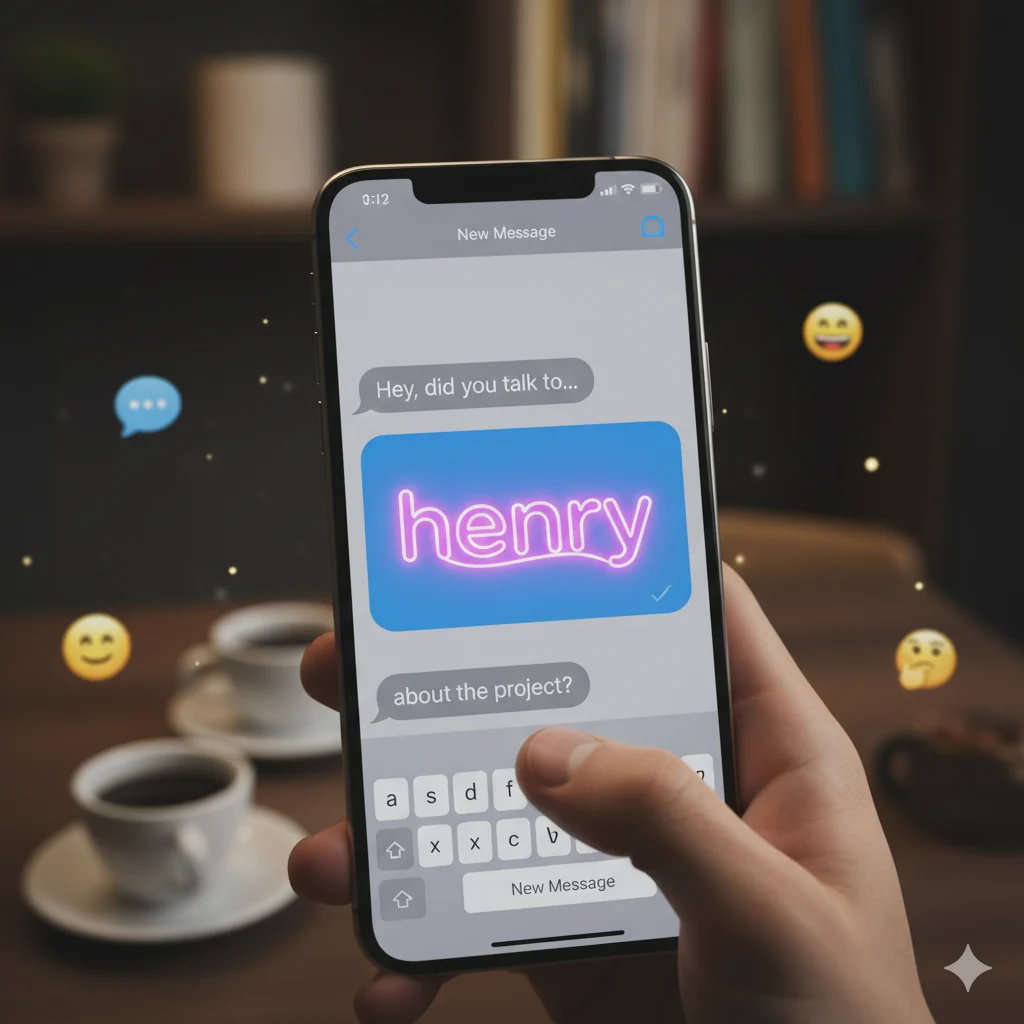

Ever been mid-scroll through a group chat, laughing at memes, when a message stops you cold? There it was, nestled between a “lol” and a fire emoji: “henry.” Your brain does a quick reboot. Wait, who’s Henry? Did I miss someone joining the chat? Is this an inside joke? You stare at your screen, suddenly feeling like a digital archaeologist trying to decipher a lost language. We’ve all been there. Text slang evolves faster than a viral TikTok trend, and “henry” is one of those stealthy newcomers that can leave you utterly perplexed. But don’t worry—you’re not out of the loop. You’re just about to become the expert.
“Henry” means “Hurry Up.” It’s a playful, often slightly impatient or teasing way to tell someone to speed things along, commonly used among friends in casual digital conversations.
🧠 What Does Henry Mean in Text?
Forget the history books and kings. In the fast-paced world of texting, DMs, and social media comments, “henry” has undergone a complete linguistic makeover. It is not a person’s name; it’s a clever, phonetic shorthand. The word is derived from the phrase “HEN-RY,” which sounds out the first syllable of “HENRY” as a stand-in for the entire command “Hurry.”
Think of it as verbal texting—a way to shorten a common phrase by how it sounds when spoken quickly. It’s similar to how “u” stands for “you” or “gr8” means “great.” When someone drops a “henry” in your messages, they are essentially saying, “Speed it up!” or “What’s taking so long?”
Example: “We’re all waiting outside… henry!”
In short: henry = Hurry Up = A casual, phonetic nudge to move faster.
📱 Where Is Henry Commonly Used?
You won’t find “henry” in formal reports or professional emails. Its natural habitat is the casual, often time-sensitive world of digital peer-to-peer communication. It thrives in environments where brevity and a bit of personality are key.
- 💬 Group Chats (iMessage, WhatsApp, Telegram): The most common home for “henry.” Perfect for nudging a friend who’s taking forever to pick a food order or get ready.
- 🎮 Gaming Chats (Discord, in-game messaging): Used to rally the squad or push teammates during a match. “henry to point B!”
- 📸 Social Media DMs (Instagram, Snapchat): Often seen when coordinating meet-ups or reacting to someone taking too long to send a promised photo.
- ✈️ Travel or Event Coordination: When friends are trying to find each other in a crowd or make a departure time.
Tone & Formality: “Henry” is firmly in the casual and social-media–friendly category. It can carry a tone of playful impatience, lighthearted teasing, or urgent camaraderie. It is not formal, polite, or appropriate for communicating with superiors, clients, or in any serious or sensitive situation.
💬 Examples of Henry in Conversation
Seeing “henry” in action is the best way to understand its vibe. Here are 5 real-world chat examples:
- The Late FriendA: omw, just need to find my keys
B: dude, the movie starts in 10… henry! 🏃♂️ - The Game LobbyA: brb, grabbing a drink
B: henry pls, the match is starting!! 🎮 - The Decision-MakerA: I can’t decide between the black shoes or the white ones…
B: henry, we’re gonna be late! just wear the black ones 👟 - The Photo DelayA: wait, let me take a better one
B: henry and send it! the story is fading in 2 sec 😂📸 - The Food OrderA: hmm, maybe the burger… or the salad…
B: we’ve been here for 10 mins. henry up, the server is coming! 🍔
🕓 When to Use and When Not to Use Henry
Navigating slang is all about context. Using “henry” correctly means knowing the right and wrong moments for that playful nudge.
✅ WHEN TO USE HENRY:
- With close friends and family who understand your humor.
- In casual, time-sensitive group chats.
- To express playful impatience in a low-stakes situation (like choosing a Netflix show).
- In gaming or social media environments where quick communication is standard.
❌ WHEN TO AVOID HENRY:
- In professional emails, messages to your boss, or work Slack channels.
- During serious, urgent, or stressful situations (e.g., a real emergency).
- With people you don’t know well or who might not be familiar with modern slang.
- When genuine patience and politeness are required.
Context Comparison Table
| Context | Example Phrase | Why It Works / Doesn’t Work |
|---|---|---|
| Friend Chat | “The Uber’s here, henry! 🚗” | Casual, direct, and fitting for the relaxed, urgent tone. |
| Work Chat | “Please expedite the report.” | “Henry” is unprofessional. Clear, polite language is required. |
| Formal Email | “Kindly submit at your earliest convenience.” | “Henry” is much too informal and could be seen as rude. |
| Gaming | “henry, they’re planting the spike!” | Perfect for fast-paced, team-based communication. |
🔄 Similar Slang Words or Alternatives
“Henry” is part of a whole family of slang used to communicate urgency, patience, or timing in a casual way. Here are some of its cousins:
| Slang | Meaning | When to Use |
|---|---|---|
| ASAP | As Soon As Possible | More urgent than “henry.” Works in semi-professional and casual contexts. |
| TYT | Take Your Time | The opposite of “henry.” Used to tell someone there’s no rush. |
| RN | Right Now | Indicates immediate action is needed. Can be more demanding than “henry.” |
| SMH | Shaking My Head | Expresses disbelief or disappointment, often at someone’s slowness. |
| FR | For Real | Can be used to emphasize urgency: “FR, henry!” |
| On God | I swear / Seriously | Adds heavy emphasis to a request: “On god, henry up.” |
❓ FAQs About Henry
Is “henry” flirty?
Not typically. Its core meaning is about speed and mild impatience, not romance. However, like any slang, tone is key. In a very specific, teasing context between people who are flirting, it could be used playfully (“henry and get over here 😉”), but its primary function is not flirty.
Who uses “henry” the most?
It’s most popular among teens and young adults (Gen Z and younger Millennials) who are heavy users of messaging apps, social media, and online gaming platforms where this type of abbreviated, phonetic slang evolves quickly.
Can “henry” be considered rude?
It can be, if used in the wrong context. Telling a stranger, an elder, or a colleague to “henry” would likely be perceived as disrespectful or overly familiar. Its acceptability depends entirely on your relationship with the recipient.
What’s the difference between “henry” and “hurry up”?
“Henry” is the casual, insider, phonetic version. “Hurry up” is the standard English phrase. “Henry” adds a layer of digital-native familiarity and is often perceived as less harsh than a blunt “Hurry up.”
How do I reply to “henry”?
A simple acknowledgment is fine! Replies like “omw!”, “2 secs!”, “kk!”, or even a speeding car emoji 🏎️ are all appropriate. The key is to signal you’ve received the nudge.
💎 Conclusion
So, the next time “henry” pops up in your messages, you won’t miss a beat. You’ll know it’s not about a person, but a playful push toward the finish line—a tiny, phonetic emblem of our need for speed in digital conversation. It’s a testament to how language constantly reinvents itself in our pockets, creating shortcuts that bond those in the know. Use “henry” wisely with your inner circle to add a dash of casual urgency, but remember to switch back to full, clear phrases when the situation demands more formality. Now that you’re in on the secret, you can confidently tell your friends to “henry” along and catch up! 😉