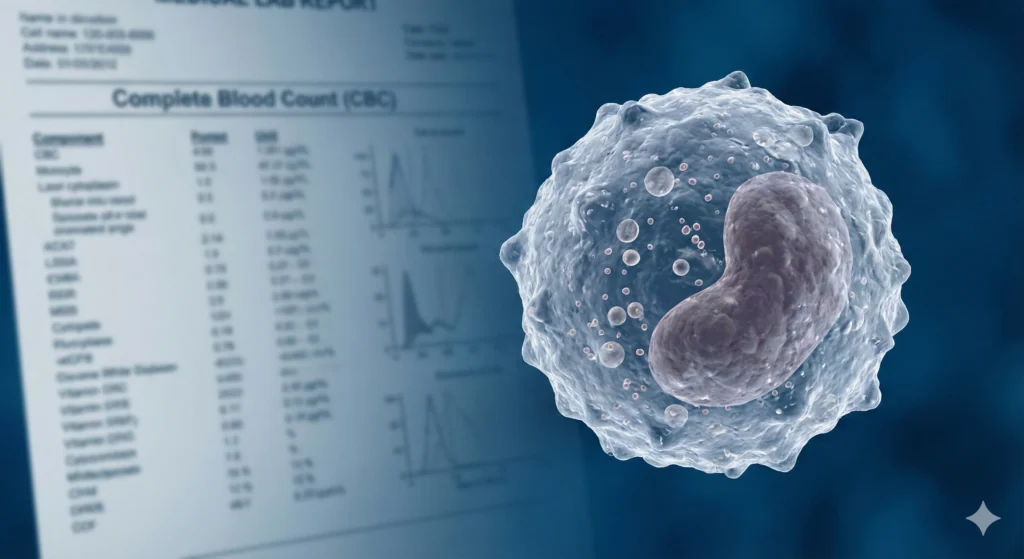

You just got a copy of your bloodwork from your annual physical. You feel great—no fever, no fatigue, you’re your normal self. But as you scan the dense page of abbreviations and numbers, your eyes lock on one line: Monocytes: HIGH. A cold wave of “what if” crashes over you. Is it an infection? Something more serious? You’re suddenly a detective with a single, alarming clue, and Dr. Google is giving you answers that range from “it’s nothing” to worst-case scenarios. Take a deep breath. Seeing “high monocytes” for the first time is confusing for almost everyone, but it’s often a sign your body is doing its job, not a definitive diagnosis.
In medical terms, “high monocytes” means you have monocytosis—a higher-than-normal count of monocytes, a type of white blood cell, in your blood. It’s your body’s way of signaling it’s fighting something, often a routine infection, inflammation, or recovering from an illness. It’s a clinical clue, not a disease itself.
🧠 What Does a High Monocyte Count Mean?
Let’s break it down simply. Your blood contains different types of white blood cells (your body’s defense army). Monocytes are the special forces within that army. When your body detects an invader (like bacteria or a virus) or needs to clean up damaged tissue, it sends out more of these special forces. They travel from your bloodstream into your tissues, where they transform into macrophages—essentially “Pac-Man” cells that engulf and destroy pathogens and debris.
A high monocyte count, or monocytosis, is like your body calling in reinforcements. The lab flags it as “high” when your absolute monocyte count (AMC) exceeds about 0.95 x 10^9/L (this range can vary slightly by lab).
Example: Imagine you’re getting over a bad sinus infection. Your doctor runs blood tests and says, “Your monocytes are still a bit elevated, which is normal as your immune system is winding down from that fight.”
In short: High Monocytes = Monocytosis = Your immune system is actively engaged or recently has been.
🔬 What Are the Common Causes of High Monocytes?
Monocytosis is a reaction, not a root cause. It points your doctor toward the underlying issue. The reasons generally fall into a few categories:
- Infections: This is the most common cause. Your monocytes ramp up to combat:
- Bacterial infections (e.g., tuberculosis, endocarditis).
- Viral infections (e.g., mononucleosis, cytomegalovirus).
- Fungal or parasitic infections.
- Chronic Inflammation & Autoimmune Diseases: Long-term inflammation keeps your immune system on alert.
- Conditions like rheumatoid arthritis, lupus, inflammatory bowel disease (Crohn’s, ulcerative colitis), or vasculitis.
- Recovery Phase: After an acute infection, injury, or even a surgery, monocytes can stay elevated during the clean-up and healing process.
- Hematologic (Blood) Conditions: This is what many people worry about, but it’s less common.
- Myelodysplastic syndromes and certain types of leukemia (like chronic myelomonocytic leukemia – CMML) can cause monocytosis.
- It’s crucial to remember this is only one possible cause among many more likely ones.
- Other Causes: Certain cancers, smoking, stress response, and even corticosteroid medication use.
📱 How Is a High Monocyte Count Diagnosed and Evaluated?
You won’t feel “high monocytes.” It’s a finding on a test called a Complete Blood Count (CBC) with differential. If your monocytes are flagged as high, your doctor doesn’t stop there. They become a detective, using this clue to guide the next steps:
- Look at the Big Picture: They will examine all parts of your CBC. Are other white cells high? Is your red blood cell or platelet count off? The full pattern is key.
- Review Your Symptoms: Do you have a fever, fatigue, unexplained weight loss, bone pain, or night sweats? Your symptoms provide the most critical context.
- Consider Your Medical History: Do you have a known autoimmune condition? Are you recovering from an illness?
- Order Follow-Up Tests: Depending on the suspicion, they may order:
- Blood Smear: A pathologist looks at your blood cells under a microscope.
- Inflammation Markers: Tests like ESR or CRP.
- Infection Work-ups: Specific tests for viruses, bacteria, etc.
- Imaging: X-rays or CT scans if looking for sources of infection or inflammation.
- Bone Marrow Biopsy: This is only ordered if there is strong suspicion of a serious blood disorder, based on the entire clinical picture.
What Does the Name Ethan Mean? ✨
💬 Real-Life Scenarios: What Your Doctor Might Say
Let’s translate this into the conversations you might actually have.
- Scenario 1: Post-InfectionPatient: “So, my bloodwork says my monocytes are high. Should I be worried?”
Doctor: “Not at all. Given that nasty chest cold you had two weeks ago, this is exactly what I’d expect. Your immune system is still a bit activated. Let’s recheck in a month—it should be back to normal.” - Scenario 2: During an Autoimmune FlarePatient: “My lupus has been flaring, and now my monocytes are up.”
Doctor: “That tracks. The inflammation from the flare is stimulating your bone marrow. We’ll focus on getting your lupus under better control with your medication, and the monocytes should follow.” - Scenario 3: An Isolated FindingPatient: “I feel perfectly fine, but my annual labs show high monocytes.”
Doctor: “Since you have no symptoms and the rest of your CBC is perfect, this is likely an incidental finding. However, to be thorough, we’ll repeat the CBC in 8-12 weeks to ensure it normalizes.”
🕓 When to Be Concerned vs. When It’s Likely Benign
It’s natural to worry, but context is everything.
✅ When High Monocytes Are Often Less Concerning (Reactive Monocytosis):
- You are currently fighting or recently recovered from an infection.
- You have a known inflammatory condition that is active.
- The elevation is mild and all other blood counts are normal.
- You have no other unexplained symptoms (like fever, significant fatigue, weight loss, easy bruising).
❌ When High Monocytes Warrant More Investigation:
- The count is very high or persistently rising over repeat tests.
- It’s accompanied by other abnormal blood counts (low red cells/anemia, low platelets, abnormal white cells).
- You have “B symptoms”: unexplained fever, drenching night sweats, significant weight loss.
- You feel bone pain or have unexplained bruising/bleeding.
🔄 Other Important Blood Count Terms You Might See
Understanding related terms can help you read your CBC report.
| Term | Meaning | Context with Monocytes |
|---|---|---|
| Leukocytosis | High overall white blood cell count. | Monocytes are one part of this. All white cell types might be up in an infection. |
| Lymphocytosis | High lymphocyte count. | Often seen in viral infections. Your doctor compares this to your monocyte count. |
| Neutrophilia | High neutrophil count. | The most common rise in acute bacterial infections. |
| Pancytopenia | Low counts of ALL blood cell types. | A serious finding. If monocytes are high despite low other cells, it requires urgent evaluation. |
❓ FAQs About High Monocytes
Q1: Can stress cause high monocytes?
A: Yes, chronic physical or emotional stress can trigger a mild, temporary increase in monocytes as part of the body’s overall stress response.
Q2: What level of monocytes is considered dangerously high?
A: There’s no single “dangerous” number. A count above 1.0 x 10^9/L is typically considered high, but the concern level depends on trends over time and the presence of other abnormalities. A count persistently above 2.0-3.0 certainly requires a thorough work-up.
Q3: Should I see a specialist for high monocytes?
A: Start with your primary care physician. They will perform the initial evaluation. If needed, they may refer you to a hematologist (blood specialist) or an immunologist/rheumatologist (if an autoimmune cause is suspected).
Q4: How can I lower my monocyte count?
A: You don’t treat the number; you treat the underlying cause. If it’s due to an infection, healing will lower it. Managing inflammation in autoimmune disease, quitting smoking, or reducing chronic stress can help. There is no specific “monocyte-lowering” diet or supplement.
Q5: Are high monocytes a sign of cancer?
A: They can be, particularly in certain blood cancers, but this is relatively rare. Infection and inflammation are far more common causes. Never jump to this conclusion based on a single lab value without your doctor’s full assessment.
🧭 Conclusion:
Finding “high monocytes” on your lab report is a moment for informed attention, not panic. It is a messenger, not the message itself. The most important action you can take is to schedule a follow-up with your doctor to discuss the result in the context of your health. Bring your questions, a list of any symptoms (even minor ones), and your personal and family medical history. Avoid the rabbit hole of internet searches, which will inevitably show you the rarest, scariest possibilities. Trust the process: your doctor will use this clue, alongside your story and a careful exam, to determine if it’s a benign sign of your body doing its heroic work or a pointer that needs a deeper look. Your health is a story, and this is just one data point in a much larger chapter.