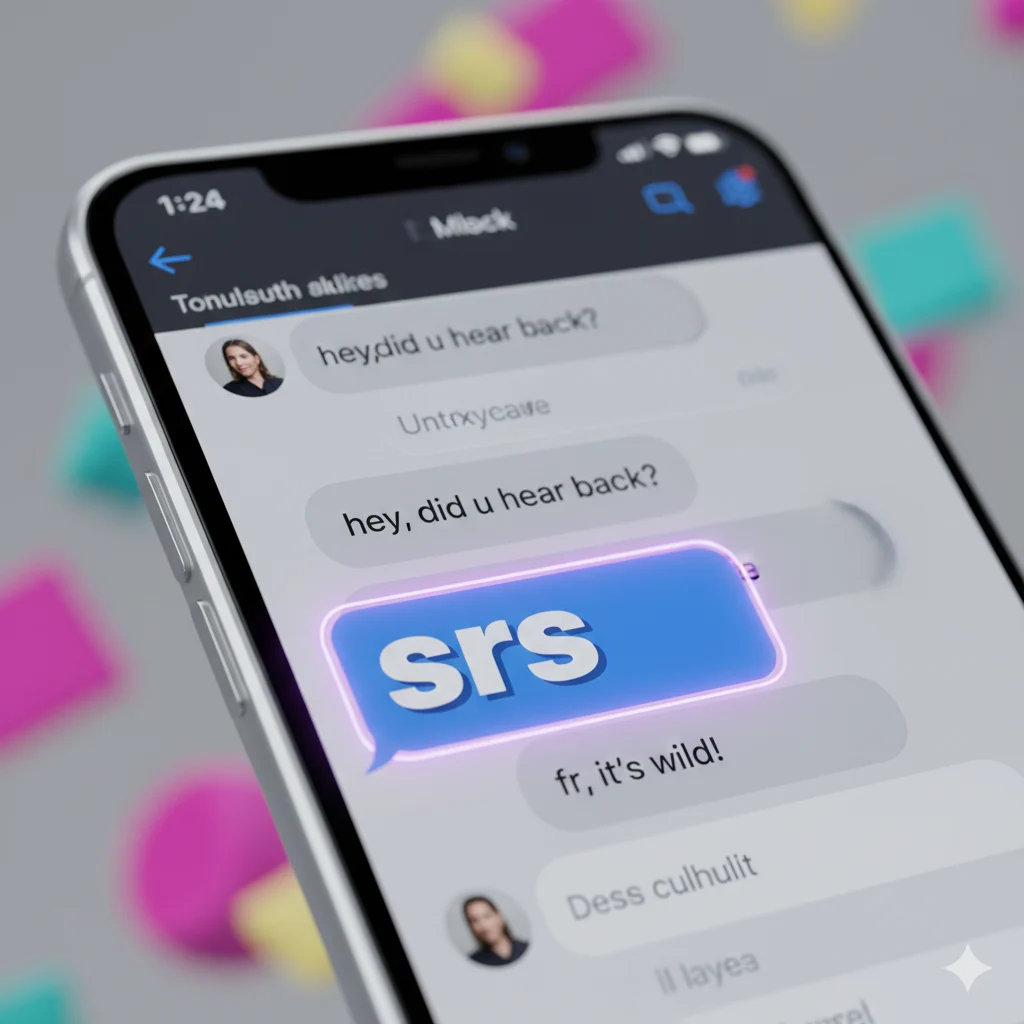

You’re scrolling through your DMs, laughing at a meme your friend sent, when their next message gives you pause: “ok but srs tho…” You stare at the three-letter acronym. Is it a typo? A new secret code? Your brain races through possibilities—”sorry”? “seriously”?—and you feel that familiar, mild panic of being out-of-the-loop on internet slang. We’ve all been there. One minute you’re fluent in textspeak, and the next, a new abbreviation pops up and leaves you decoding like a digital archaeologist. If “srs” has you scratching your head, don’t worry—you’re not alone, and the answer is simpler than you think.
SRS means “Serious.” It’s a casual, often emphatic way of saying “for real,” “no joking,” or “I’m being genuine” in texting and social media.
🧠 What Does SRS Mean?
Let’s cut right to the chase. SRS is a straightforward abbreviation for the word “serious.” It’s part of the vast family of internet and texting slang designed for speed and efficiency, born from the need to type less while conveying the same tone and meaning.
In practice, srs is rarely used to describe a grave or solemn situation (like “a serious illness”). Instead, it’s a conversational tool primarily used for two purposes:
- To emphasize sincerity: Switching from a joking tone to a genuine one.
- To ask for sincerity: Prompting someone else to stop joking and give a real answer.
Think of it as the textual equivalent of dropping your smile, leaning in, and saying, “Okay, but honestly…” It adds a layer of emotional nuance to flat text.
Example Sentence: “I know we were joking about moving to Bali, but srs, would you ever consider it?”
In short: SRS = Serious = A way to highlight honesty or demand a genuine response in casual conversation.
📱 Where Is SRS Commonly Used?
SRS is a child of informal digital communication. You won’t find it in corporate emails or academic papers, but it’s thriving in spaces where conversation is quick and relational.
- 💬 Text Messaging (SMS/iMessage): Its primary home. Used between friends to pivot conversations from silly to sincere.
- 📸 Snapchat & Instagram DMs: Perfect for following up on a streak or story reply with a genuine question.
- 🎮 Gaming Chats (Discord, In-Game Messaging): Gamers use it to quickly coordinate (“srs, we need a healer”) or call out teammates’ actions.
- 🐦 X (Formerly Twitter) & TikTok Comments: Used to express earnest agreement or ask sincere questions in a public thread.
- 💬 Facebook Messenger & Group Chats: Common in casual group conversations among peers.
Tone & Formality: SRS is strictly casual and social-media–friendly. It’s for conversations with friends, family, or close acquaintances. Using it with someone you don’t know well or in a professional context would be considered inappropriate and unprofessional.
💬 Examples of SRS in Conversation
Seeing srs in action is the best way to understand its flow. Here are 5 realistic chat examples:
1. Switching from Joking to Sincere:
A: lmao imagine if we just quit our jobs and became beekeepers
B: okay but srs… are you actually happy at your job lately?
2. Asking for a Genuine Opinion:
A: your new haircut is… interesting 😅
B: srs. do you hate it?
A: srs, no! it just takes a second to get used to. it’s cool!
3. Expressing Earnest Concern:
A: i think i failed that exam.
B: oh no! srs?
A: srs. i blanked on the entire last section.
4. Emphasizing a Point in Planning:
A: movie night at 8? don’t be late!
B: i’ll try!
A: srs tho, the previews start at 8:15.
5. In a Group Chat Dynamic:
Alex: who’s actually going to Jake’s party Saturday?
Sam: me maybe
Taylor: srs, Alex? we need a headcount.
Alex: srs, i’m going. put me down.
🕓 When to Use and When Not to Use SRS
Knowing when not to use a slang term is just as important as knowing its meaning.
✅ When to Use SRS:
- With close friends and family in informal chats.
- To gently steer a silly conversation toward a more heartfelt topic.
- To show you’re genuinely concerned or asking a genuine question.
- To playfully emphasize a request or instruction among peers.
- In fast-paced, casual digital environments (gaming, social media DMs).
❌ When NOT to Use SRS:
- In work emails, formal letters, or any professional correspondence.
- When discussing truly serious, sensitive, or tragic news (use the full word “serious”).
- With authority figures, clients, or people you don’t know well.
- In situations requiring immediate, unambiguous clarity (e.g., emergencies).
- If you suspect it might be misinterpreted as sarcasm.
Context Comparison Table
| Context | Example Phrase | Why It Works (or Doesn’t) |
|---|---|---|
| Friend Chat | “srs, thank you for listening to me yesterday. 💖” | Adds a tone of heartfelt sincerity in a casual setting. |
| Work Chat | “Seriously, we need the Q3 data by noon.” | The full word “seriously” maintains professionalism and gravity. |
| Formal Email | “This is a serious matter that requires your attention.” | Clear, unambiguous, and appropriate for a formal channel. |
| Gaming Discord | “srs push the objective now!” | Fits the fast, abbreviated, and team-oriented communication style. |
🔄 Similar Slang Words or Alternatives
SRS sits in a family of slang used to manage tone and authenticity. Here are its closest cousins:
| Slang | Meaning | Key Difference / When to Use |
|---|---|---|
| FR | For Real | More versatile. Can mean “I agree” (“fr!”) or “Are you serious?” (“fr?”). |
| DEADASS | Being completely serious/truthful. | Stronger, more emphatic, and often regional (NYC origin). “I deadass mean it.” |
| TBH | To Be Honest | Used to preface an honest, often frank or opinionated statement. “tbh, I didn’t like that movie.” |
| NO CAP | No lie / Telling the truth. | Slang for asserting truthfulness. “I’m coming, no cap.” |
| ON GOD | A vow of truthfulness. | Very emphatic, like swearing on something sacred. “On god, I saw it.” |
| FR THO | For Real Though | Almost identical to srs. Used for emphasis after a joking statement. |
❓ FAQs About SRS
Q: Is SRS flirty?
A: Not inherently, but it can be used in a flirty context. For example, “srs, when are we finally going on that coffee date?” It introduces a note of genuine interest amidst playful banter. The tone depends entirely on the existing conversation.
Q: What does “srs bsns” mean?
A: This is a humorous, intentionally misspelled extension: “srs bsns” = “serious business.” It’s often used ironically to mock something that shouldn’t be taken seriously but is being treated with exaggerated gravity.
Q: How do I respond to someone who says “srs”?
A: Match their tone. If they’re asking for seriousness, drop the jokes and give a genuine answer. If they’re expressing sincere concern, acknowledge it earnestly. A simple “srs, yes” or “srs, no” is a perfectly natural reply.
Q: Is SRS outdated?
A: Not at all. While it’s been around for over a decade (peaking with early 2010s internet culture), it remains in steady, common use, especially among millennials and Gen Z in text-based communication. It’s a stable part of the digital slang lexicon.
Q: Can SRS be sarcastic?
A: Yes, like most text-based communication, srs relies on context. If the preceding conversation is heavily sarcastic, adding “srs” can itself be a sarcastic jab. For example, after a friend’s obvious joke: “Wow. srs groundbreaking news.“
Conclusion
: In the fast-paced world of digital chat, slang like srs acts as a linguistic shortcut, packing tone and intention into just a few letters. While its core meaning—”serious”—is straightforward, its usage is all about nuance. It can signal genuine concern, playful exaggeration, or a call for undivided attention. Remember, srs thrives in casual, friendly exchanges but has no place in formal or urgent communication. Mastering these small abbreviations is key to navigating the unspoken rules of texting etiquette and connecting more authentically with friends online. So next time you see srs, you’ll not only know what it means but exactly how to respond. 👍